Medical & Pharma Packaging · Industry Insight
Why Medical and Pharmaceutical Industries Rely on Thermoforming Packaging
Thermoforming is not one packaging option among many for pharmaceutical and medical device manufacturers — it is the foundational process behind sterile barrier packaging, pharmaceutical blister, and GMP-compliant device trays. This article explains why, and what regulated industries should expect from a thermoforming packaging manufacturer.
In this article
1. Why Thermoforming is Central to Medical and Pharma Packaging
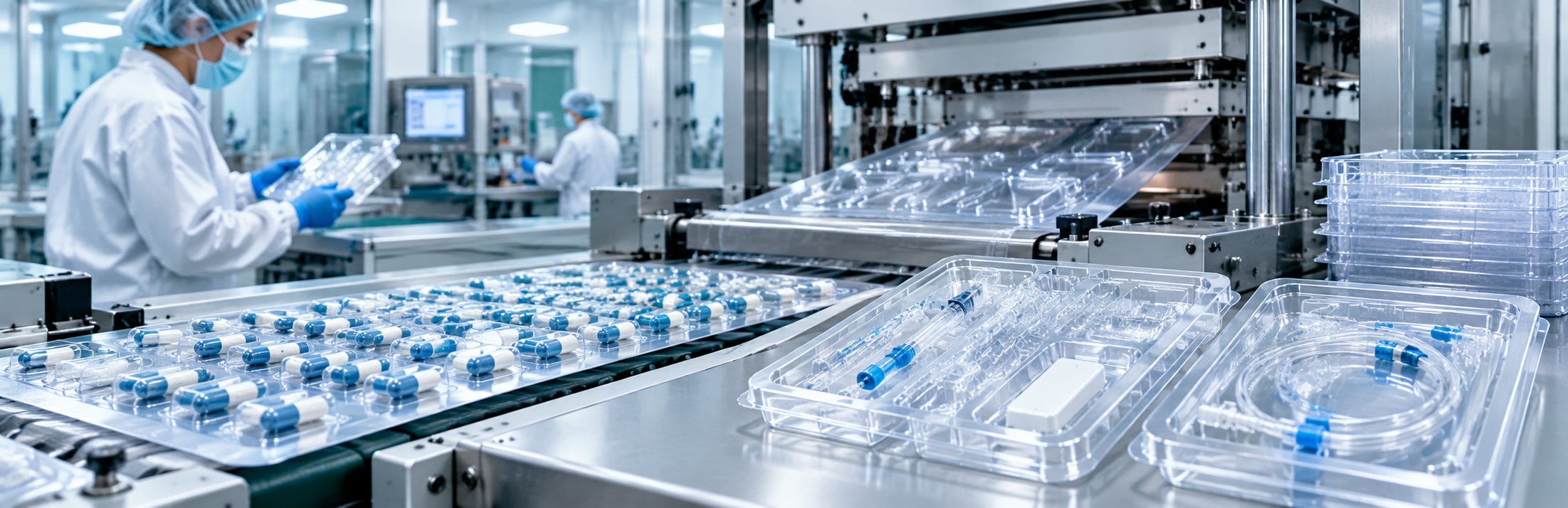
Walk into any hospital dispensary, operating theatre, or pharmaceutical distribution centre in India — and you are surrounded by thermoformed packaging. Blister packs holding oral solid dose medicines. PETG trays cradling surgical instruments. Tyvek-sealed blister packs protecting implants and catheters. Every one of these is produced by thermoforming.
This is not coincidence. Thermoforming has specific properties that make it structurally suited to the requirements of regulated pharmaceutical and medical device packaging in ways that other packaging processes cannot replicate at comparable cost and speed:
- 🎯 Custom cavity geometry for every product. Every medical device has a unique shape. Thermoforming produces a custom cavity — dimensioned to the exact product geometry — from CNC-fabricated tooling in 7 to 14 days. No other rigid packaging process offers this combination of customisation speed and production economics.
- 🔬 Sterile barrier compatibility. Thermoformed PETG and APET blister trays are heat-sealable with Tyvek — the global sterile barrier material for medical device packaging. This combination forms the sterile barrier system defined by ISO 11607, the international standard for sterile medical device packaging.
- 💊 Pharmaceutical blister — the global OSD standard. PVC and PVDC thermoformed blister packaging is the dominant format for oral solid dose pharmaceutical products globally. Every pharmaceutical blister pack — from paracetamol strips to antibiotic blister cards — is produced by thermoforming.
- 🏭 GMP-compatible manufacturing process. Thermoforming can be performed under pharmaceutical GMP with batch records, material traceability, in-process controls, and Cleanroom Class 8 environmental monitoring — the full documentation chain required by pharmaceutical and medical device procurement.
- ⚗️ ETO and Gamma sterilization compatibility. PETG, PP, and APET thermoforming materials are compatible with ETO and Gamma sterilization — the two dominant sterilization methods for medical devices. The thermoformed packaging component can be loaded with the device and sterilized in the pack.
2. The Sterile Barrier System — What It Is and Why Thermoforming Is Central
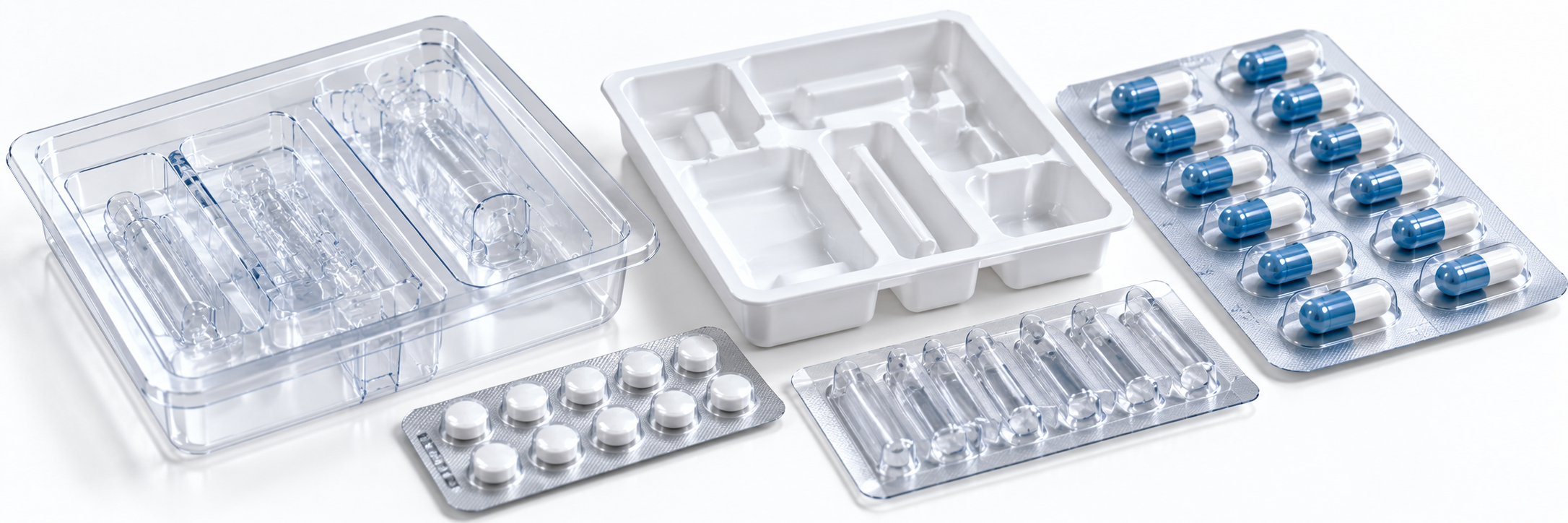
A sterile barrier system (SBS) is a packaging system that maintains sterility of a medical device from the point of manufacture to the point of use. ISO 11607 Part 1 and Part 2 define the requirements for sterile barrier systems and for the processes used to produce them.
The thermoformed blister is the most widely used sterile barrier system component for medical devices. It consists of two elements:
- 1️⃣ The thermoformed tray component. Thermoformed from PETG or APET in ETO and Gamma compatible medical-grade material. The cavity is dimensioned to hold the device securely and present it correctly for clinical use. Produced in a Cleanroom Class 8 environment to reduce particulate contamination risk.
- 2️⃣ The Tyvek lid. Tyvek (DuPont) is a medical-grade spunbonded olefin material that is gas-permeable (allowing ETO sterilization) and microbial-barrier (maintaining sterility post-sterilization). Heat-sealed to the thermoformed tray flange to form a sealed sterile barrier system.
For medical device OEMs, this means the thermoforming packaging manufacturer is a critical upstream supplier — one who must produce to a defined material specification, dimensional tolerance, sealing flange geometry, and environmental standard before the device ever reaches the packaging line.
3. Pharmaceutical Blister Packaging — The Thermoforming Standard
Thermoforming in medical packaging India extends far beyond devices. Pharmaceutical blister packaging for oral solid dose (OSD) products — tablets and capsules — is produced by thermoforming globally and in India without exception.
The Three Pharmaceutical Blister Formats
| Format | Material | WVTR | Best For |
|---|---|---|---|
| PVC Blister | Pharmaceutical-grade PVC, heat-sealed with aluminium foil | 3.0–5.0 g/m²/day | Standard OSD products with low to moderate moisture sensitivity. The global default pharmaceutical blister format. |
| PVDC Blister | PVC/PVDC laminate or PVDC homopolymer, heat-sealed with aluminium foil | 0.5–2.0 g/m²/day | Moisture-sensitive and hygroscopic drug products requiring higher barrier protection than standard PVC. |
| Alu-Alu Cold Form | Aluminium-based laminate (OPA/Alu/PVC), cold-formed — not thermoformed with heat | <0.1 g/m²/day | Highly moisture-sensitive, hygroscopic, and light-sensitive drug products requiring maximum barrier protection. |
The choice of blister format is determined by the drug product's moisture sensitivity and stability profile — defined in the product's pharmaceutical development and stability studies. The packaging specification flows from the regulatory submission.
GMP Pharmaceutical Blister — What "GMP" Means in Practice
Pharmacopoeial-grade materials: PVC and PVDC used for pharmaceutical blister must be manufactured to pharmacopoeial specification (USP, BP, EP) by the material manufacturer. The COA from the material manufacturer confirms compliance.
Validated sealing parameters: The heat-seal cycle — temperature, dwell time, pressure — is validated to ensure consistent seal integrity across the production batch. Seal integrity is tested per batch.
Batch records: Every pharmaceutical blister production batch has a complete GMP batch record — material lot numbers, process parameters, in-process QC results, outgoing inspection result, and release decision. Provided to the pharmaceutical manufacturer with every batch.
Change control: Any change to material specification, tooling, or process parameters triggers a formal change control procedure — with risk assessment and customer notification before implementation.
Pharmaceutical Blister Packaging Manufacturer in India
GMP validated pharmaceutical blister — PVC, PVDC, Alu-Alu — from our Cleanroom Class 8 facility at Vapi. Full documentation per batch. ISO 9001:2015 · GMP · Cleanroom Class 8.
4. Medical Device Thermoforming Packaging — 8 Therapy Areas
Medical device thermoforming packaging spans the complete range of therapeutic areas — each with its own device geometry, sterility requirement, and clinical use context:
5. GMP and Cleanroom Class 8 — What Regulated Industries Should Expect
When a pharmaceutical company or medical device OEM qualifies a thermoforming packaging manufacturer as a supplier, three certifications form the quality infrastructure they should expect:
- 📋 ISO 9001:2015 — Quality Management System. The baseline quality certification. Ensures that material procurement, production, inspection, documentation, and corrective action are all within a documented, audited quality management system. Required for all regulated packaging applications.
- 🏭 GMP — Good Manufacturing Practice. Pharmaceutical packaging manufacturing practice: material traceability per batch, in-process controls, batch records, seal integrity testing, change control, cleaning and contamination prevention. Validated — not simply claimed. Required for pharmaceutical primary packaging production.
- 🧪 Cleanroom Class 8 — Controlled Production Environment. ISO 14644-1 classified and independently validated controlled environment. Maintained by HEPA-filtered air supply and monitored per production session. Required for medical device blister component manufacturing and pharmaceutical blister where environmental control is specified.
Request Our Supplier Qualification Package
ISO 9001:2015 certificate · GMP validation documentation · Cleanroom Class 8 classification — available for review before order placement.
6. Materials for Regulated Thermoforming Packaging Applications
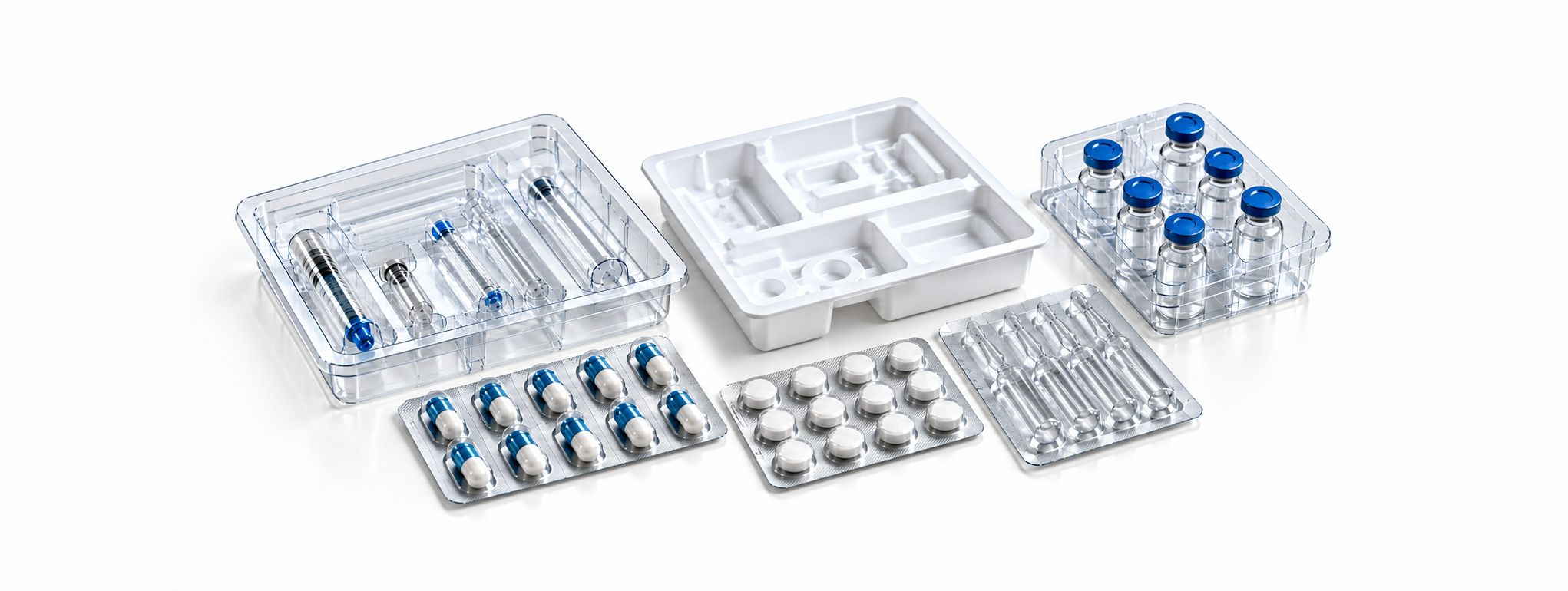
Regulated thermoforming packaging requires specific material grades — not standard commercial grades. The material grade is a specification of the plastic material itself, confirmed on the material manufacturer's COA:
| Material | Grade for Regulated Use | ETO Compatible | Gamma Stable | Application |
|---|---|---|---|---|
| PETG | Medical-grade — biocompatibility evaluated by material manufacturer | ✓ Yes | ✓ Yes | Medical device blister tray component — primary choice |
| PP | Medical-grade / food-grade — grade confirmed on material COA | ✓ Yes | ✓ Yes | Medical device trays, pharmaceutical trays, syringe trays |
| APET | Medical-grade or food-grade — BPA-free | Limited | ✓ Yes | Medical device packaging, ophthalmic device trays |
| PVC | Pharmaceutical-grade — manufactured to pharmacopoeial specification | ✓ Yes | Limited | Pharmaceutical OSD blister — global standard |
| PVDC | Pharmaceutical-grade — higher barrier specification | ✓ Yes | Limited | High-barrier pharma blister for moisture-sensitive drug products |
7. The Documentation Chain — What Regulated Buyers Should Receive
The documentation chain for regulated thermoforming packaging is as important as the physical packaging. For pharmaceutical company and medical device OEM supplier qualification, the documentation package per production batch should include:
| Document | Contents | Required For |
|---|---|---|
| GMP Batch Record | Batch number, material lot numbers, production date, operator records, in-process parameters, QC results, outgoing inspection result, release decision. | All pharmaceutical GMP and medical device batches — standard |
| Material COA | Material identity, grade specification (pharma-grade, medical-grade), lot number, test results — from the material manufacturer, passed through by the thermoformer. | All regulated batches — standard |
| Cleanroom Session Record | Environmental monitoring data, HEPA filter status, gown log, operator records — per production session, aligned to the specific batch. | Medical device blister and pharma Cleanroom batches |
| Seal Integrity Record | Seal integrity test results for the production batch — per validated test method. Critical for pharmaceutical blister and medical device blister. | All blister packaging batches |
| In-Process QC Data | Dimensional inspection, visual inspection records, per-batch statistical summary. | All batches — in GMP batch record or separately |
All documentation should be retained by the thermoforming manufacturer for a minimum of 5 years post-production for supplier audit access.
8. India's Pharma Manufacturing Corridor — Why Local Thermoforming Capability Matters
India is the world's third-largest pharmaceutical producer by volume — home to the largest number of US FDA-approved pharmaceutical manufacturing facilities outside the United States. The pharmaceutical manufacturing clusters in Vadodara, Baddi, Hyderabad, Ahmedabad, Ankleshwar, and Mumbai collectively produce a substantial share of the world's generic drug supply.
This scale creates a strategic case for local GMP thermoforming packaging capability — specifically for pharmaceutical primary packaging components produced close to the pharmaceutical manufacturing site:
Shorter supply chain reduces validation risk: A local GMP thermoforming packaging supplier reduces the logistics complexity of pharmaceutical primary packaging supply — particularly important for temperature-sensitive or regulatory-sensitive packaging material supply chains.
Faster response to specification changes: When a pharmaceutical product specification changes — new dosage form, new pack configuration, regulatory variation — a local thermoforming manufacturer can respond to tooling and specification changes in 7 to 14 days, versus weeks for international suppliers.
Supplier audit accessibility: Pharmaceutical company supplier qualification processes require on-site audits. A local GMP thermoforming packaging manufacturer — accessible from the same manufacturing corridor — reduces the audit logistics cost and enables more frequent qualification visits.
Made in India packaging for Made in India pharma: India's pharmaceutical export competitiveness increasingly requires documented "Made in India" supply chains — including packaging. Local GMP thermoforming capability supports this documentation requirement.
Medical & Pharma Thermoforming Packaging — Qualified at Vapi
GMP pharmaceutical blister · Cleanroom Class 8 medical device blister components · ISO 9001:2015 certified pharmaceutical and medical device trays. Submit your brief for a 24-hour response.