Manufacturing Innovation · Industry 4.0
How Industry 4.0 is Transforming Thermoforming Packaging Manufacturing
Industry 4.0 is changing what buyers should expect from a thermoforming packaging manufacturer — not just "we have machines" but connected process monitoring, digital quality data, CNC precision tooling, and faster prototype-to-production timelines. This article examines what the transformation means for regulated and commercial packaging programmes.
In this article
1. What Industry 4.0 Means for Thermoforming Packaging
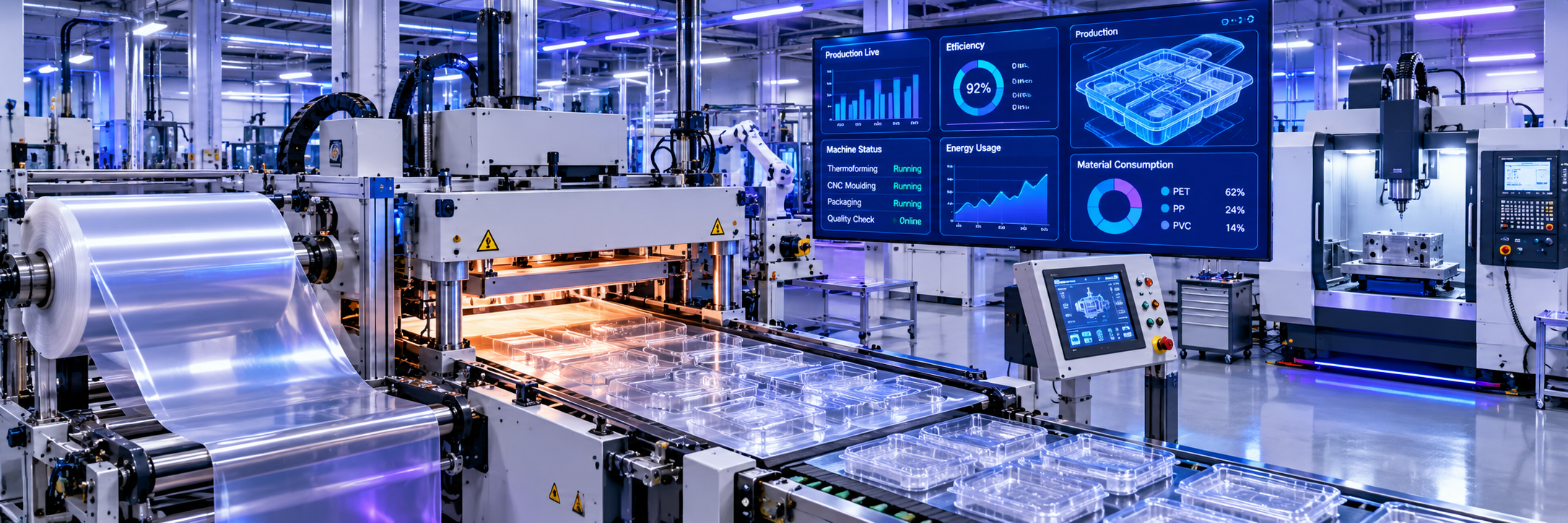
Industry 4.0 — the fourth industrial revolution — is shorthand for the integration of digital technologies into manufacturing: connected sensors, data-driven process control, digital design tools, automation, and real-time quality monitoring. For packaging manufacturers, the transformation is tangible and buyer-visible.
Five years ago, a thermoforming packaging buyer would submit a product sample, wait six weeks for a prototype tooled by an external tool room, and receive paper batch records with their production batch. Today, a manufacturer with Industry 4.0 capability delivers a physical prototype in 7 to 14 business days from in-house CNC tooling, provides digital GMP batch records with full lot traceability, and monitors forming process parameters in real time to maintain production consistency.
For pharmaceutical companies, medical device OEMs, and automotive manufacturers — industries where documentation, consistency, and speed are procurement criteria — Industry 4.0 is not a technology discussion. It is a packaging supply chain performance discussion.
2. The 4 Pillars of Industry 4.0 in Thermoforming — What They Mean in Practice
3. CNC Tooling — The Prototyping Revolution for Packaging Buyers
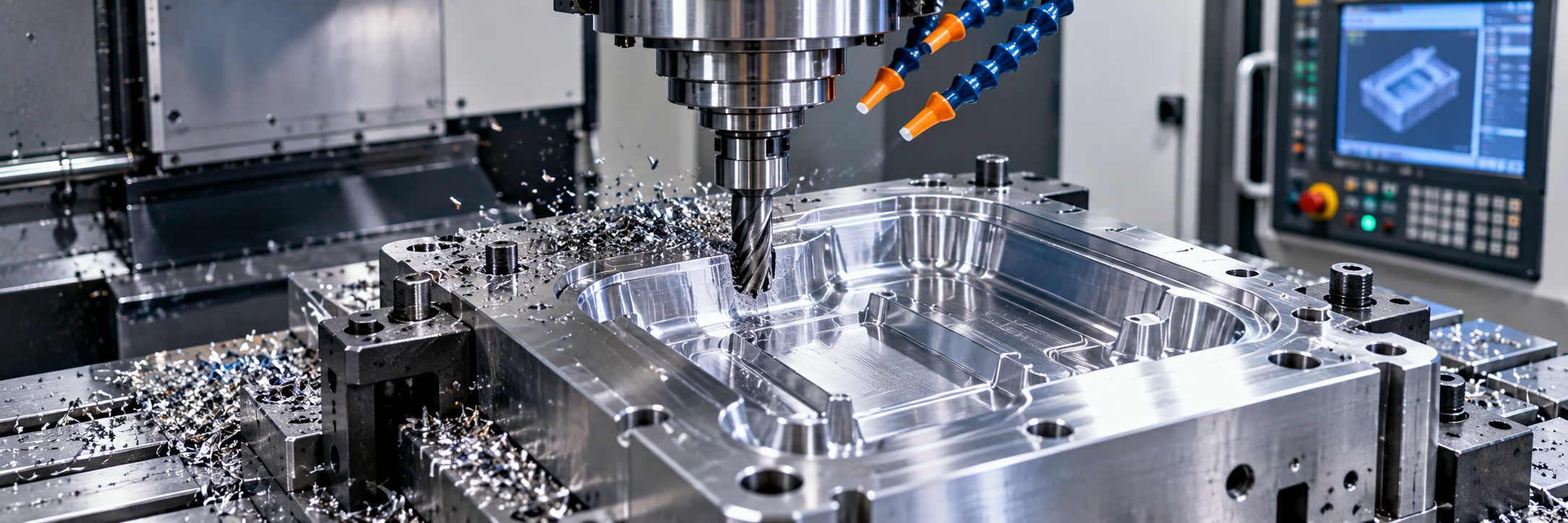
The single most buyer-visible impact of Industry 4.0 on thermoforming packaging is the speed and precision of CNC tooling — and what it has done to prototype timelines.
The Old World: External Tool Rooms and 6-Week Waits
Before CNC became the standard tooling method, thermoforming moulds were hand-built or machined by external tool rooms — separate businesses with their own lead times, capacity constraints, and dimensional interpretation processes. Prototype tooling typically took 4 to 12 weeks. Design changes required resubmitting to the external tool room, adding another week or more per iteration.
For pharmaceutical and medical device packaging buyers with product launch timelines, this tooling lead time was often the longest single item in the packaging development schedule.
The New World: In-House CNC and 7-14 Day Prototypes
- ⚡ Design to tooling in a single digital workflow. CAD cavity geometry is output directly to CNC machining instructions. No manual dimension transfer. No interpretation gap between designer and tool room.
- ⚡ 7 to 14 business days from brief to physical prototype. In-house CNC tooling fabricated at the same Vapi facility as production thermoforming. No external tool room queue. No logistics delay between toolmaker and former.
- ⚡ ±0.5mm dimensional tolerance. CNC machining achieves and maintains the dimensional tolerance required for precision packaging applications — medical device blister trays, pharmaceutical diagnostic kit trays, and automotive component nests.
- ⚡ Modifications at the facility. When first prototype review requires a cavity modification, the CNC file is updated and the tool is reworked in-house — same day or next day for minor changes. No external coordination.
- ⚡ Digital tooling records. CNC tool paths, revision history, and dimensional inspection records are stored digitally — providing a complete tooling audit trail per packaging format that supports supplier qualification documentation.
7 to 14 Days from Brief to Physical Prototype
In-house CNC tooling at Vapi — design to prototype without leaving the facility. All 6 thermoforming formats. ISO 9001:2015 certified.
4. Digital Quality Data and GMP Documentation — What It Means for Regulated Industries
For pharmaceutical and medical device packaging buyers, the Industry 4.0 quality data conversation is not about technology — it is about what documentation they receive and how easily it supports their regulatory and audit processes.
What Digital GMP Documentation Delivers
Complete lot traceability: Every material lot — rPET, PVC, PETG, pharmaceutical-grade PVC — is digitally linked to the specific production batch it was processed in. The material COA from the material manufacturer is indexed to the batch. Searching the traceability chain takes seconds rather than hours of paper file review.
In-process parameter records per batch: Forming temperature, cycle time, sheet temperature, and cooling parameters are logged per production session — creating a digital process record that supports pharmaceutical GMP and ISO 9001:2015 in-process control requirements.
Dimensional inspection data: For medical device and pharmaceutical packaging requiring dimensional conformance (±0.5mm tolerance for blister tray cavity geometry), automated or digitally-assisted dimensional inspection provides per-batch statistical data — not just a pass/fail record.
Seal integrity records: For blister packaging, seal integrity test results per batch are digitally recorded and retrievable. The specific test parameters, samples tested, and results are stored as part of the batch documentation rather than in a separate paper file.
Cleanroom session monitoring: Environmental monitoring data from Cleanroom Class 8 production sessions — temperature, humidity, HEPA filter status — digitally recorded per session and linked to specific production batches in the GMP documentation system.
5. Then vs Now — What Industry 4.0 Has Changed for Packaging Buyers
Digital Documentation for Your Supplier Qualification
GMP batch records, material COAs, Cleanroom session records — all available in digital format. Full lot traceability per batch. Retained 5 years.
6. Industry 4.0 Benefits by Industry
| Industry | How Industry 4.0 Benefits Their Packaging Programme | Key Capability |
|---|---|---|
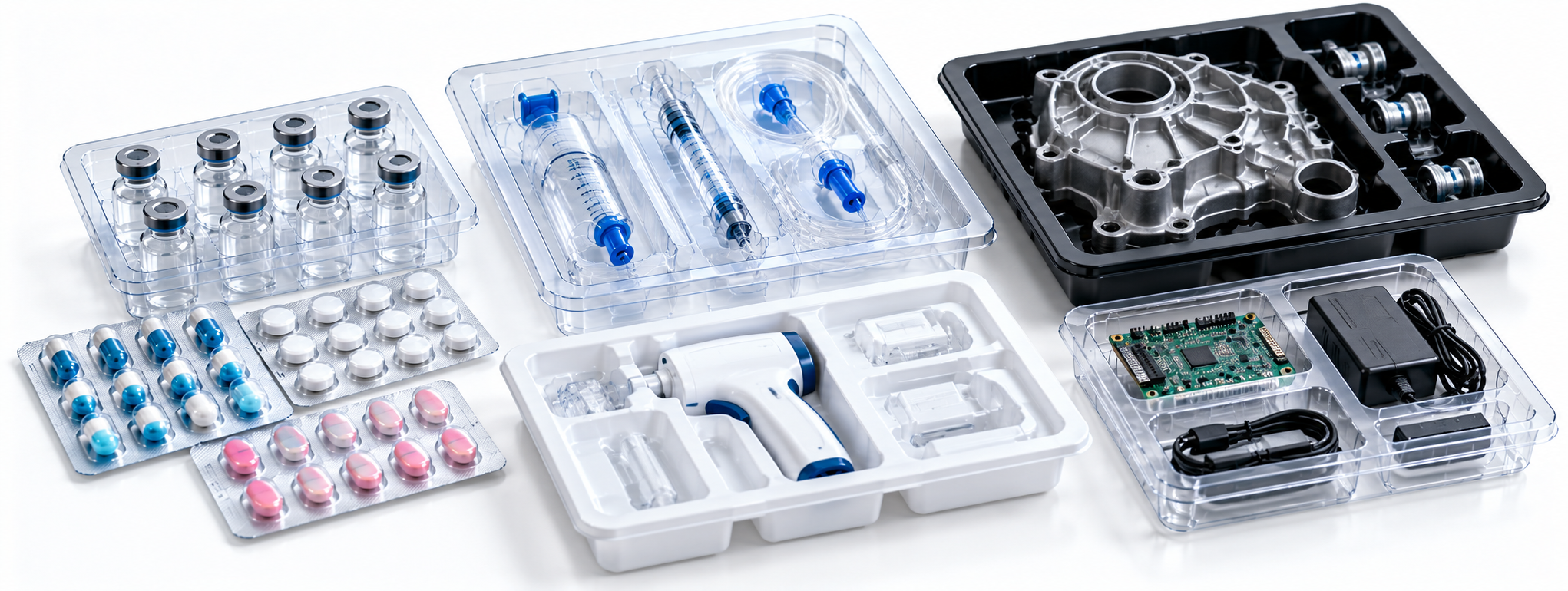
| 💊 Pharmaceutical | Digital GMP batch records with full lot traceability reduce supplier audit time. Process parameter logging supports in-process control documentation. Seal integrity data per batch in digital format for regulatory submissions. | Digital GMP documentation · Seal integrity records |
| 🏥 Medical Devices | CNC precision tooling delivers ±0.5mm dimensional tolerance for PETG blister tray components. Cleanroom session monitoring data digitally linked to batch records for ISO 11607 sterile barrier documentation. | CNC ±0.5mm tolerance · Digital Cleanroom records |
| 🚗 Automotive | CNC-precision component nest geometry ensures consistent part location across high-volume assembly line tray programmes. Digital tooling records support supplier qualification with Tier 1 and OEM automotive procurement. | CNC nest precision · Digital tooling records |
| ⚡ Electronics | In-house CNC tooling enables fast iteration for consumer electronics accessories packaging — where product redesign cycles are short and packaging changes need to track product changes quickly. | Fast tooling iteration · 7–14 day prototypes |
| ✨ Cosmetics & FMCG | CAD-to-CNC design workflow enables complex cosmetic insert geometries — embossed branding panels, precision cavity arrays — that distinguish premium packaging on shelf. Faster concept-to-prototype for seasonal programmes. | Complex geometry · Fast seasonal prototyping |
7. What Hasn't Changed — And Why That's Important
Industry 4.0 is a real transformation in thermoforming manufacturing. But it is worth being direct about what it has not changed — because the unchanged fundamentals are as important as the technology upgrades.
- 🔧 Thermoforming is still a skilled craft. Digital design tools and CNC machines require skilled operators who understand thermoforming — draw ratios, wall thickness distribution, material behaviour at forming temperature, sealing parameters. Industry 4.0 amplifies the output of skilled thermoforming knowledge. It does not replace it.
- 🎯 Material knowledge still determines quality. Selecting the right material grade — medical-grade PETG, pharmaceutical-grade PVC, food-contact APET — is a knowledge decision, not a digital one. 20 years of thermoforming experience across regulated materials informs this decision in ways that no software system can replicate.
- 📋 GMP is a process discipline, not a technology. GMP compliance is built on procedure, training, documentation discipline, and change control — not on the software platform that stores the records. Digital tools make GMP documentation faster and more searchable. They do not create GMP capability where it does not exist.
- 🤝 The brief still starts with the product sample. Industry 4.0 can accelerate the journey from product sample to physical prototype to production. But the journey still starts with a packaging engineer reviewing the product — its dimensions, fragility, regulatory context, and handling requirements — before a single CNC programme is written.
8. Smart Thermoforming Manufacturing India — What to Look For in a Manufacturing Partner
Smart thermoforming manufacturing in India means different things from different manufacturers. Here is a practical evaluation checklist — what buyers should look for when assessing whether a thermoforming packaging manufacturer has genuine Industry 4.0 capability:
- ✅ In-house CNC tooling — not outsourced. Prototype in 7–14 business days. Ask: "Is your prototype tooling made in-house?" An honest answer to this question separates genuine capability from a claim.
- ✅ Digital process parameter records per batch. Ask: "Can you provide digital process parameter records for a production batch?" For GMP pharmaceutical and medical device programmes, these should be standard batch documentation — not a special request.
- ✅ Dimensional inspection data with statistical summary. Ask: "What format does your dimensional inspection data come in?" Statistical per-batch data supports pharmaceutical GMP and automotive quality documentation requirements better than a simple pass/fail certificate.
- ✅ ISO 9001:2015 certified quality management system. The digital quality system must sit within an audited, certified quality management framework. ISO 9001:2015 certification is the verification that the digital systems are being used consistently, not just in place.
- ✅ GMP validation and Cleanroom Class 8 for regulated applications. For pharmaceutical and medical device packaging programmes, digital quality capability without GMP validation and Cleanroom Class 8 classification is incomplete. The technology and the regulatory certification must coexist.
Industry 4.0-Capable Thermoforming Manufacturer — Vapi, India
In-house CNC tooling · Digital GMP records · 7–14 day prototypes · ISO 9001:2015 · GMP · Cleanroom Class 8. Submit your brief for a 24-hour response from our Vapi packaging engineers.
In-house CNC tooling · Digital GMP records · 7–14 day prototypes · ISO 9001:2015 · GMP · Cleanroom Class 8. Submit your brief for a 24-hour response from our Vapi packaging engineers.