Manufacturing Insights · Thermoforming Processes
Vacuum Forming vs Pressure Forming — Which Process is Right for Your Packaging?
Both vacuum forming and pressure forming produce thermoformed plastic packaging — but the right process depends on your detail requirement, application, and budget. This guide explains the difference and helps you choose.
In this article
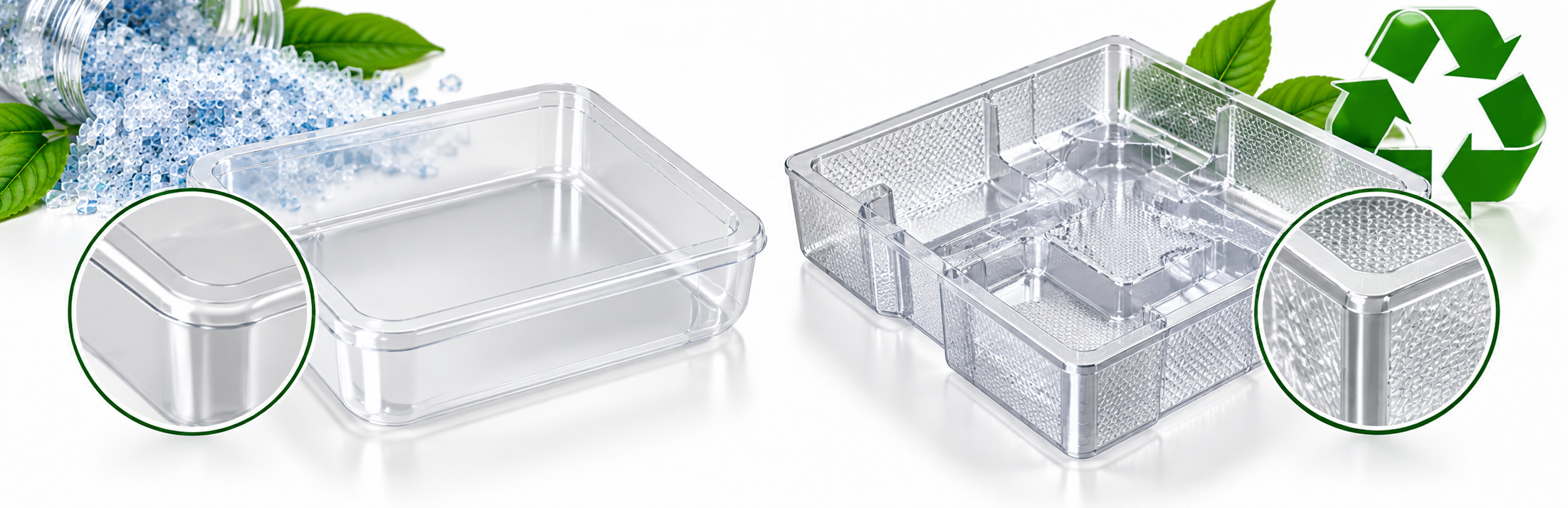
1. What is Vacuum Forming?
Vacuum forming is the foundational thermoforming process. A plastic sheet is heated until pliable, then drawn down over a single-sided mould by pulling a vacuum beneath it. Atmospheric pressure — approximately 1 bar — is the forming force.
- 🔵 Single-sided tooling. The plastic contacts only one side of the mould — the tool-side surface. The opposite face is formed by atmospheric pressure alone.
- 🔵 ~1 bar forming force. The forming force is limited to the difference between atmospheric pressure and the vacuum. This limits the achievable surface detail and corner sharpness.
- 🔵 Lower tooling cost. Single-sided mould, simpler construction. Lower upfront tooling investment than pressure forming.
- 🔵 Best for standard geometry. Good surface definition on the tool-contact side. The opposite face shows no surface detail — it reflects the stretched sheet only.
2. What is Pressure Forming?
Pressure forming adds compressed air pressure on top of the heated sheet — forcing it against the mould with 4 to 11 bar of combined force, up to 10× the force of vacuum forming alone.
- 🟣 Pressure + vacuum combined. Compressed air above the sheet pushes while vacuum below pulls — the plastic is driven into the mould cavity with far greater force than vacuum forming alone.
- 🟣 4–11 bar forming force. Significantly higher pressure enables sharper corners, finer surface textures, undercuts, and double-sided surface detail.
- 🟣 ±0.5mm dimensional tolerance. Pressure forming achieves dimensional accuracy approaching injection moulding — at thermoforming tooling cost.
- 🟣 Injection moulding quality, thermoforming cost. Complex surface geometry, logos, textures, and functional features that would require injection moulding can be achieved by pressure forming — at a fraction of the tooling investment.
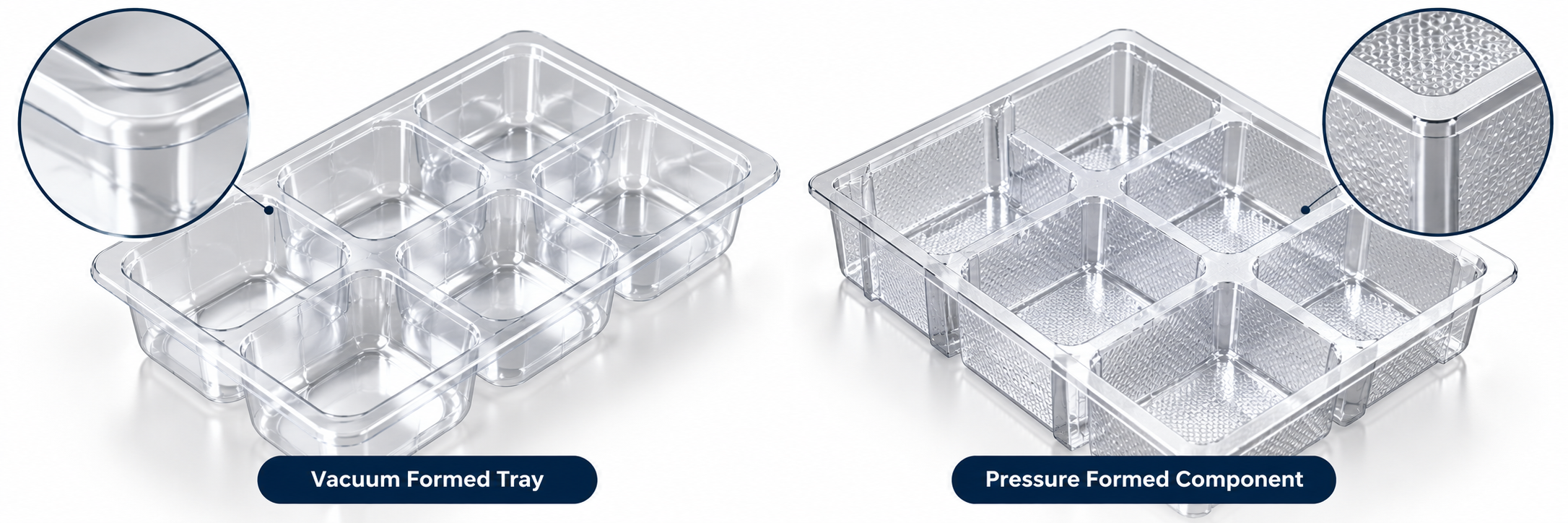
3. Side-by-Side Comparison
| Parameter | 🔵 Vacuum Forming | 🟣 Pressure Forming |
|---|---|---|
| Forming Force | ~1 bar (atmospheric only) | 4–11 bar (pressure + vacuum combined) |
| Surface Detail | Good on tool-contact side only | Sharp detail on both sides — logos, textures, ribs |
| Corner Sharpness | Rounded corners — limited by forming force | Crisp, sharp corners comparable to injection moulding |
| Dimensional Tolerance | Standard — ±1–2mm typical | ±0.5mm — approaching injection moulding |
| Tooling Cost | Lower — simpler single-sided mould | Higher — matched tooling required for pressure side |
| Production Speed | Higher — simpler process, faster cycle times for standard geometry | Slightly lower — higher complexity per cycle |
| Gauge Range | 0.3–8mm | 0.3–8mm — same range, wider application |
| Material Compatibility | PP, HIPS, ABS, PETG, APET, PVC, ESD | PP, HIPS, ABS, PETG, APET, PVC, ESD |
| Best For | Standard trays, commercial packaging, high-volume FMCG | Medical devices, automotive precision, premium retail, industrial enclosures |
4. When to Choose Vacuum Forming
Vacuum forming is the right process when your packaging requirement is:
Standard cavity geometry — rectangular or curved trays where sharp corner detail and two-sided surface definition are not required.
High volume commercial programmes — FMCG trays, retail inserts, stationery packaging, toy packaging, food service trays where tooling cost efficiency and production speed are priorities.
Single-sided surface requirement — the packaging only requires a defined surface finish on the tool-contact side. The opposite face is visible only as a smooth sheet surface.
Lower tooling budget — when the packaging application does not justify the higher tooling investment of pressure forming, vacuum forming delivers a cost-efficient thermoforming solution.
Heavy gauge structural panels — at gauges above 4mm for industrial enclosures and large machinery covers, vacuum forming handles thick-section geometry effectively without the added complexity of pressure tooling.
Not Sure Which Process Is Right for Your Packaging?
Share your product sample or drawing. Our team will recommend vacuum forming or pressure forming — and explain why — within 24 hours.
5. When to Choose Pressure Forming
Pressure forming is the right process when your packaging requirement is:
Medical device packaging components — PETG blister trays and medical device trays where tight dimensional tolerance (±0.5mm) ensures consistent fit and reliable peel-open performance.
Automotive precision component trays — component nest geometry requiring tight tolerance for secure part location during assembly line handling, preventing contact damage.
Premium retail packaging — cosmetic inserts, gift set display trays, and consumer electronics packaging where surface texture, embossed branding, or sharp geometric aesthetics differentiate the product on shelf.
Industrial enclosures with functional features — equipment panels, machinery casing, and power tool packaging in ABS or PP where snap-fit features, defined parting lines, and surface finish comparable to injection moulding are required.
Replacing injection moulding — when a design that would normally require injection moulding tooling (₹15–60 lakh+) can be produced by pressure forming tooling (significantly lower investment) without sacrificing the surface quality or dimensional accuracy the application requires.
6. Cost and Tooling Comparison
| Cost Factor | Vacuum Forming | Pressure Forming | Injection Moulding |
|---|---|---|---|
| Tooling type | Single-sided mould | Matched male/female mould | Full cavity and core steel mould |
| Tooling complexity | Lower | Medium | Highest |
| Relative tooling cost | Lowest | Medium | Highest (3–10× thermoforming) |
| Prototype timeline | 7–14 business days | 7–14 business days | 6–12 weeks typical |
| Per-unit cost at volume | Low | Low–Medium | Lowest at very high volume |
| Design change cost | Low — tool modification | Low–Medium | High — steel modification |
Both Processes. One Facility. One Supplier Qualification.
Vacuum forming and pressure forming from the same Vapi facility — ISO 9001:2015 certified. No split supplier programmes.
7. Applications by Industry
| Industry | Typical Vacuum Forming Applications | Typical Pressure Forming Applications |
|---|---|---|
| 💊 Pharmaceutical | Ampoule and vial trays, syringe trays, sample kit packaging, large-volume diagnostic tray arrays | Precision syringe nest trays with tight dimensional tolerance, diagnostic kit trays with defined cavity geometry |
| 🏥 Medical Devices | Standard device trays, large blister components for lower-complexity devices | PETG blister tray components requiring ±0.5mm tolerance — catheter trays, implant packaging, ophthalmic device trays |
| 🚗 Automotive | Assembly line staging trays, bulk component transit trays, protective covers | Precision component nest trays for ECU, sensor, and connector packaging — defined cavity geometry for contact-sensitive parts |
| ✨ Cosmetics | Standard gift set trays, inner packaging inserts, cost-efficient retail tray programmes | Premium cosmetic display inserts with embossed branding, textured surface, and sharp geometry for luxury retail packaging |
| ⚙️ Industrial | Large equipment covers, machinery protective housings, bulk industrial packaging | Equipment enclosure panels and power tool retail packaging requiring injection-moulding-equivalent surface quality in ABS |
| 🛒 FMCG & Retail | Confectionery gift trays, display inserts, shelf-ready packaging, most high-volume commercial formats | Premium FMCG retail packaging with brand texture or logo embossing where shelf differentiation is a commercial priority |
8. How Trizen Uses Both Processes
As a thermoforming manufacturer with both vacuum forming and pressure forming capability in-house at Vapi, Trizen Packaging selects the process as part of the packaging design brief — based on application requirement, not which process happens to be available.
Process recommendation as part of your brief: When you submit a product sample and packaging requirement, we recommend vacuum forming or pressure forming — explaining the technical basis for the recommendation before tooling begins.
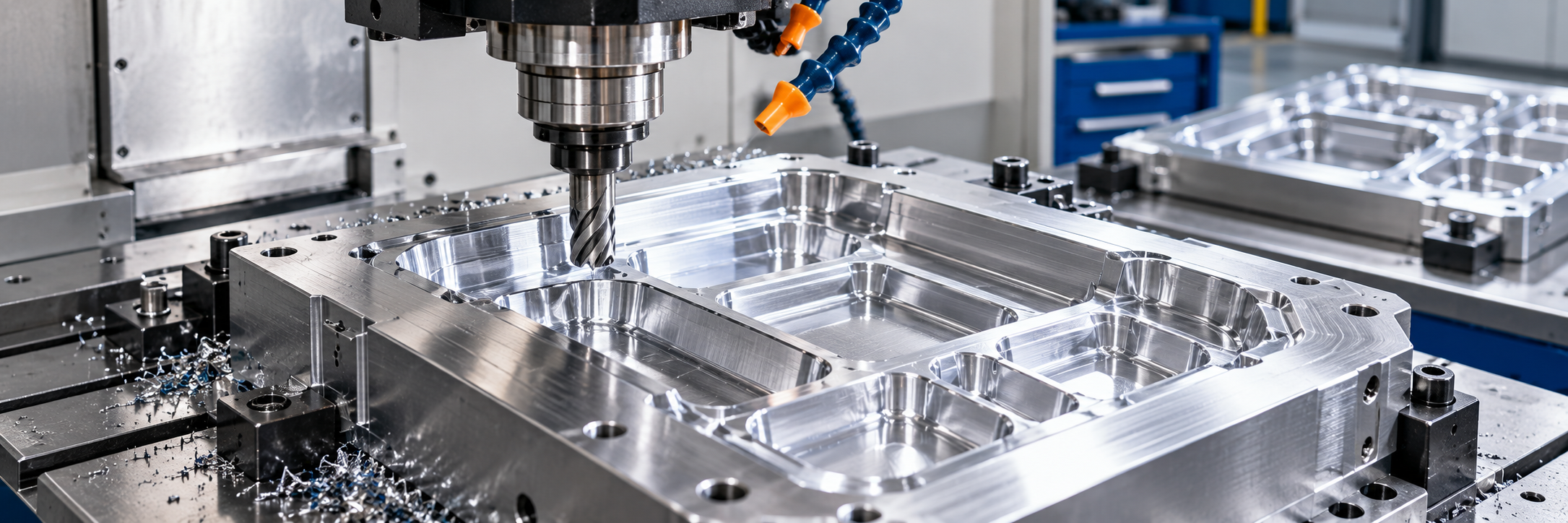
In-house CNC tooling for both processes: All vacuum forming and pressure forming tooling is designed and CNC-fabricated in-house at Vapi. Prototype in 7 to 14 business days for both processes.
Multi-format programmes using both processes: Some packaging programmes require both — for example, vacuum formed transit trays for logistics and pressure formed retail display packaging for the same product. Both from one Vapi facility, one ISO 9001:2015 quality system.
Process upgrade path: Some packaging programmes start with vacuum forming at prototype stage — then upgrade to pressure forming for the commercial run when the detail requirement becomes clear. In-house tooling makes this process change straightforward without supplier changes.
Vacuum Forming or Pressure Forming — We'll Tell You Which One
Submit your product sample or drawing. Our packaging engineers review the application and recommend the right process, material, and tooling approach — within 24 business hours.