Pressure Forming Packaging Manufacturer IndiaPrecision Thermoforming for Medical, Pharmaceutical and Automotive Applications, Vapi
Injection moulding surface quality at thermoforming tooling cost. In-house CNC pressure forming tooling at Vapi — first prototype in 7 to 14 business days.
When Vacuum Forming Is Not EnoughThe Case for Pressure Forming
Most thermoforming manufacturers default to vacuum forming for every application. It works well for standard packaging geometries. But there is a category of requirements where vacuum forming consistently falls short:
Trizen Packaging is a pressure forming packaging manufacturer in India applying 4 to 11 bar of combined vacuum and compressed air forming force to produce precision thermoformed packaging for medical device, pharmaceutical, automotive, and premium commercial applications from in-house CNC tooling at Vapi. The same product that fails in vacuum forming is produced to specification by pressure forming — without the tooling cost or lead time of injection moulding.
As a pressure forming packaging manufacturer in India, we confirm the correct process from the product sample before any tooling is committed. If vacuum forming can meet your specification, we say so. If pressure forming is required — first prototype in 7 to 14 business days from our in-house Vapi CNC facility.
| When Vacuum Forming Fails | What Actually Happens | Why Pressure Forming Solves It |
|---|---|---|
| Medical device cavity fitment fails | The device rocks, shifts, or can be removed without resistance. Sterile barrier not maintained. Device orientation for clinical use is compromised. | 4–11 bar drives the sheet into precise mould geometry — cavity walls hold the device at exact orientation with the tolerances required. |
| Sharp corner definition is required | Vacuum forming produces rounded corners of 1–3mm in deep draws. Pharmaceutical blister sealing areas and cosmetic insert corners look soft and imprecise. | Compressed air pressure drives the sheet into sharp corner geometry — sub-1mm radius achievable. Crisp edge definition comparable to injection moulding. |
| Wall thickness inconsistent in deep draws | Significant wall thinning at draw points. Packaging base thick, cavity walls thin. Structural integrity fails under product load. | Pressure forming maintains consistent wall thickness throughout cavity depth — critical for medical device tray and automotive component packaging. |
| Surface texture cannot be reproduced | Vacuum forming reproduces mould surface on contact face only. Fine grain texture, embossed logos, and identification marks on the opposite face are lost. | Pressure forming reproduces fine mould detail on both faces — grain, texture, branding marks sharply reproduced throughout the packaging surface. |
What Pressure Forming AchievesThe Output Difference
Pressure formed plastic packaging solutions achieve output quality measurably superior to vacuum forming in four specific performance dimensions — and comparable to injection moulding in all four:
| Dimension | Vacuum Forming | Pressure Forming | Why It Matters |
|---|---|---|---|
| Corner radius | 1–3mm radius in deep draws. Soft, rounded edges. | Sub-1mm achievable. Crisp, injection moulding-quality edges. | Pharmaceutical blister sealing area geometry. Medical device tray edge definition. Cosmetic insert corner quality. |
| Surface detail | Smooth on contact face only. Opposite face: material profile. | Fine detail both faces. Grain, texture, embossed logos sharply reproduced. | Premium brand packaging. Cosmetic gift set inserts. Product identification marks in automotive trays. |
| Wall thickness (deep) | Progressive thinning. Base thick, walls thin. | Consistent throughout cavity depth. No wall thinning at draw points. | Medical device tray structural integrity. Pharmaceutical blister base uniformity. Automotive tray load-bearing. |
| Dimensional tolerance | ±1.0–2.0mm typical | ±0.5mm achievable. Tighter on specific dimensions. | Medical device cavity fitment. Pharmaceutical sealing area flatness. Automotive precision component positioning. |
| Undercut capability | Limited — ~1 bar insufficient for complex undercuts. | Moderate undercuts achievable with correct mould design. | Complex medical device tray geometry. Automotive snap-fit packaging. Multi-component retention. |
How Pressure Forming WorksThe Process
The pressure forming process adds a second forming force — compressed air — to the standard vacuum forming cycle. Understanding the two-force system explains why pressure forming achieves output that vacuum forming cannot:
| Stage | What Happens | Pressure Forming Difference |
|---|---|---|
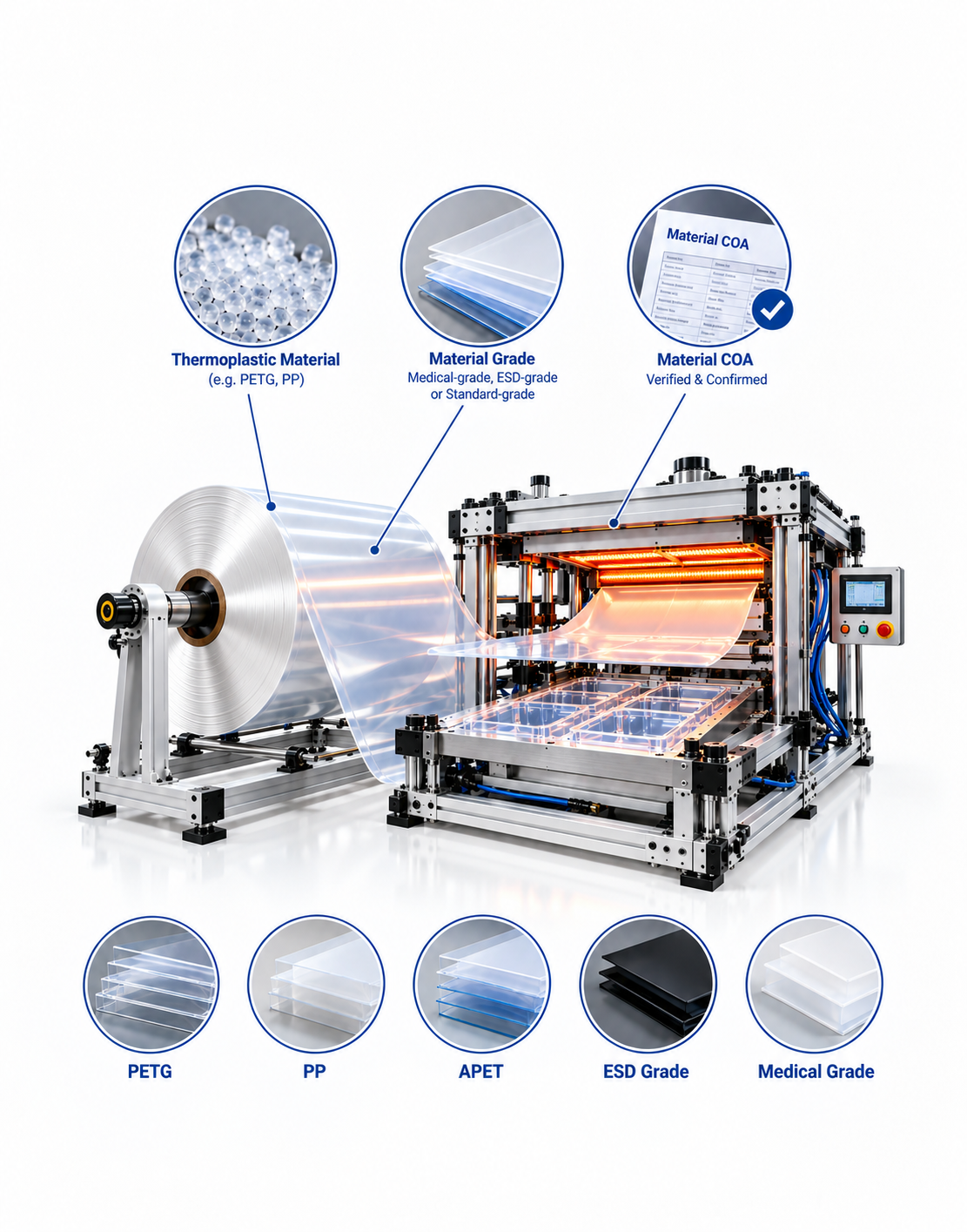
| Material Setup | Thermoplastic sheet confirmed against material COA. Medical-grade PETG or PP confirmed for regulated packaging. Material grade confirmed for Cleanroom production where required. | Same material range as vacuum forming. Medical-grade and ESD-grade confirmed at brief stage. |
| Controlled Heating | Sheet heated uniformly to forming temperature. Temperature uniformity requirements are tighter in pressure forming — non-uniform temperature produces asymmetric forming force response under the combined pressure system. | Tighter temperature uniformity requirement vs vacuum forming. Thermocouple monitoring of sheet temperature profile. |
| Stage 1 — Vacuum Draw | Vacuum applied through the mould (~1 bar) draws the heated sheet into approximate contact with the mould — the same initial stage as vacuum forming. But this is only preparation for the compressed air stage. | Vacuum stage performs initial forming. The result is not the finished form — it is the setup for Stage 2. |
| Stage 2 — Compressed Air | Compressed air at 3 to 10 bar applied to the opposite face of the sheet — simultaneously with or immediately after the vacuum draw. Combined forming force: 4 to 11 bar total. Drives the sheet into fine corner geometry, textured surfaces, deep cavity walls, and undercut geometry. | This is the pressure forming difference. 4–11× the forming force of vacuum alone. Achieves geometry that vacuum forming physically cannot. |
| Cool, Trim, Inspect | Sheet cools against the mould retaining precision geometry. Trimming and dimensional inspection. GMP batch records for all regulated medical device and pharmaceutical production runs. | GMP batch records, material COAs, and Cleanroom environmental monitoring per run for regulated packaging. |
Pressure Forming vs Vacuum FormingSpecification Comparison
A full specification comparison across the criteria that determine which process is correct for a given packaging requirement:
| Criterion | Pressure Forming (4–11 bar) | Vacuum Forming (~1 bar) | Which to Choose |
|---|---|---|---|
| Forming force | 4–11 bar combined | ~1 bar vacuum only | Pressure forming for fine detail, sharp corners, consistent deep-draw wall thickness |
| Corner radius | Sub-1mm achievable | 1–3mm typical | Pressure forming when corner definition is a specification requirement |
| Surface detail | Fine detail both faces | Contact face only | Pressure forming for embossed branding, grain texture, product identification |
| Wall thickness (deep) | Consistent throughout | Thins progressively | Pressure forming for deep cavity packaging with structural load requirement |
| Dimensional tolerance | ±0.5mm achievable | ±1.0–2.0mm typical | Pressure forming when tight tolerance is a specification requirement |
| Tooling cost | 15–30% premium | Lower baseline | Vacuum forming when process capability matches specification |
| Prototype timeline | 7–14 days in-house Vapi | 7–14 days in-house Vapi | Same timeline both processes at Trizen Packaging |
Industries and ApplicationsPrecision Packaging Across Sectors
Precision pressure forming OEM manufacturing at Trizen Packaging covers the regulated industry and premium commercial spectrum — where packaging precision is a non-negotiable specification requirement:
| Industry | Why Pressure Forming Required | Packaging Produced | Environment |
|---|---|---|---|
| Medical Devices | Device cavity fitment ±0.5mm. ETO/Gamma compatible. Sterile barrier sealing area flatness critical for peel-open sterile blister packaging. | Sterile blister trays, peel-open device trays, surgical instrument trays, implant packaging, catheter trays | Cleanroom Class 8 + GMP |
| Pharmaceutical | Blister sealing area flatness ±0.5mm. Tamper-evident and CR blister mechanism geometry precision. Pharmaceutical sealing foil adhesion requires flat, dimensionally consistent cavity base. | Pharmaceutical blister packaging (PVC, PVDC, APET), syringe trays, clinical trial sample kit trays | GMP Validated |
| Automotive Precision | Engine, transmission, and sensor component trays requiring ±0.5mm geometry for robotic pick-and-place compatibility. ECU packaging requiring ESD-safe conductive precision trays. | Precision mechanical parts trays, ECU and sensor packaging, precision assembly line trays | ISO 9001:2015 |
| Cosmetics Premium | Luxury cosmetic and perfume inserts requiring sharp corner definition, fine surface texture reproduction, and premium brand appearance comparable to injection moulding. | Perfume bottle insert trays, makeup kit inserts, luxury gift set display trays, premium retail inserts | ISO 9001:2015 |
| Electronics Precision | Precision connector and microcomponent packaging requiring ±0.5mm cavity geometry for component retention and automated handling system compatibility. | PCB packaging with component retention, precision connector trays, microcomponent packaging | ISO 9001:2015 · ESD Area |
| Diagnostics | IVD diagnostic kit trays requiring precise multi-component cavity geometry — reagent bottle cavities, sample tube holders, component sequence layout all requiring dimensional accuracy. | Diagnostic kit trays, IVD reagent packaging, companion diagnostic kit inserts | ISO 9001:2015 |
Pressure Forming Design Key Design Requirements
 Click for full photo
01 / Pressure Forming control
Material Setup
Thermoplastic sheet confirmed against material COA. Medical-grade PETG or PP confirmed for regulated packaging. Material grade confirmed for Cleanroom production where required. — Same material range as vacuum forming. Medical-grade and ESD-grade confirmed at brief stage.
Why Choose a Pressure Forming Packaging Manufacturer in India?
What makes Trizen the right pressure forming packaging manufacturer for precision OEM programmes is the combination of in-house pressure forming tooling, regulated industry credentials, and process integrity:
Related Articles

Frequently Asked QuestionsTrizen manufacturing capabilities
A pressure forming packaging manufacturer in India like Trizen Packaging produces precision rigid and semi-rigid plastic packaging — including sterile medical device trays, pharmaceutical blister packaging, automotive precision component trays, cosmetic gift set inserts, and premium retail packaging — requiring fine surface detail, sharp corner definition, and ±0.5mm dimensional tolerances that vacuum forming cannot achieve. All packaging produced from custom CNC pressure forming tooling fabricated in-house at Vapi.
Vacuum forming uses approximately 1 bar — the atmospheric pressure differential created by vacuum alone. Pressure forming adds compressed air at 3 to 10 bar to the opposite face of the sheet, creating a combined forming force of 4 to 11 bar total. This is 4 to 11 times the forming force of vacuum forming — which is why pressure forming achieves fine surface detail, sharp corners, and consistent deep-draw wall thickness that vacuum forming cannot produce.
±0.5mm on specified dimensions. For medical device cavity fitment, this is confirmed at prototype stage — the physical device sample is tested in the prototype cavity before production tooling is committed. Tighter tolerances on specific dimensions achievable depending on material, gauge, and cavity geometry — confirmed at brief and prototype stage.
Yes. All pressure formed medical device sterile trays and pharmaceutical packaging are produced in our validated Cleanroom Class 1,00,000 (Class 8) facility at Vapi. GMP batch records, material COAs, and Cleanroom environmental monitoring records provided per production run. All three validated certificates — Cleanroom Class 8, GMP, and ISO 9001:2015 — available for supplier qualification before order placement.
Ready for Precision Pressure Forming Packaging?
Submit your product sample or drawing. Our team evaluates whether pressure forming is the correct process and responds within 24 business hours. If vacuum forming meets spec, we say so.