Sustainable Packaging · Market Trends
The rPET Revolution — Why Recycled PET is Reshaping Thermoforming Packaging in India
EPR obligations have made recycled content a compliance requirement — not a preference. This article breaks down what's driving the rPET revolution, which PCR content grade your application needs, and what to demand from your thermoforming manufacturer.
In this article
1. What is rPET? Understanding Post-Consumer Recycled PET
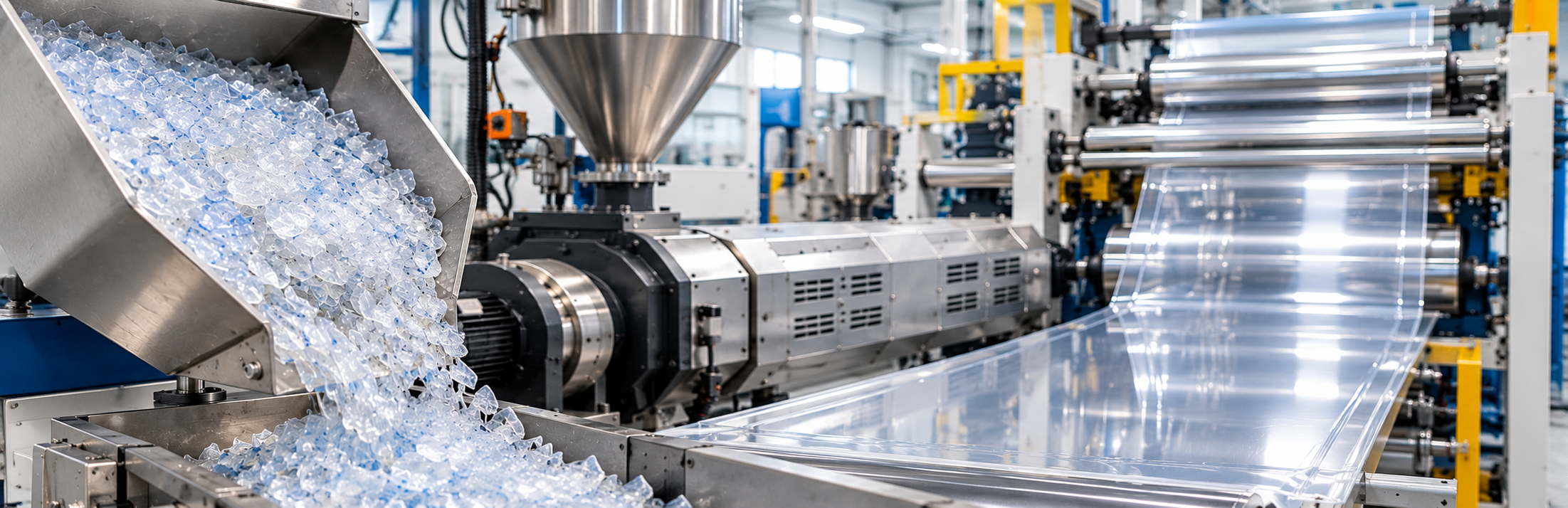
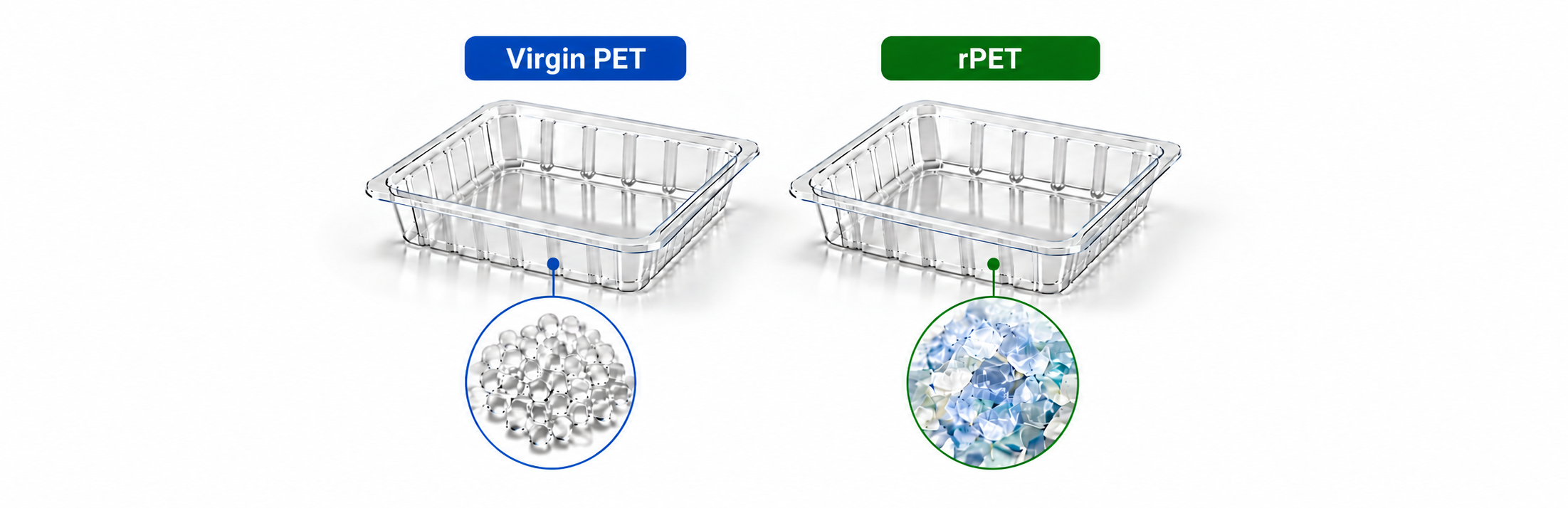
PET — polyethylene terephthalate — is the most widely recycled plastic globally. Clear PET bottles and food containers are collected, sorted, cleaned, and reprocessed into rPET flakes or pellets. These replace virgin PET resin in new plastic manufacturing — including thermoforming sheet extrusion.
There are two types of recycled PET. Only one counts for EPR compliance:
- ✓ Post-Consumer Recycled (PCR) PET — Material used by an end consumer, collected through the waste stream, and reprocessed. This is what EPR compliance and brand sustainability reporting count.
- ✗ Post-Industrial Recycled (PIR) PET — Production waste reprocessed back into the supply chain. Generally not counted towards EPR recycled content obligations.
rPET thermoforming sheet is produced by extruding rPET resin — alone or blended with virgin PET — into flat sheet. The resulting sheet is then thermoformed into trays, clamshells, retail blister packaging, and other rigid formats in essentially the same process as virgin PET.
2. The Regulatory Landscape — EPR Obligations in India
India's Extended Producer Responsibility framework, under the Plastic Waste Management (Amendment) Rules 2022, places legal obligations on producers, importers, and brand owners to meet recycled content targets in their packaging.
What EPR Requires from Packaging Buyers
Documented recycled content — not a marketing claim. EPR compliance requires certified PCR content with traceability from the recycling stream to the finished packaging.
Increasing annual targets. Recycled content targets increase year on year — what satisfies compliance today may fall short next year.
Rigid plastic is within scope. Thermoformed trays, clamshells, and blister packaging all fall within the EPR obligation structure.
Certificate-based reporting. Brands demonstrate compliance by purchasing EPR certificates representing verified recycled plastic reprocessing.
This makes your thermoforming manufacturer's documentation capability as important as their material capability. Evaluating rPET documentation at supplier qualification is now standard procurement due diligence.
Need EPR-Compliant rPET Packaging?
PCR chain-of-custody documentation included as standard with every rPET production batch. ISO 9001:2015 certified. Vapi, India.
3. Brand Sustainability Commitments and ESG Reporting
Independent of EPR, brands have made public recycled content commitments in sustainability reports and ESG filings. These are verifiable — auditors and investors check them. Two demands converge on the same supplier requirement:
- 📋 Compliance-driven (EPR) — Regulated. Enforced by government oversight. Requires certified PCR chain-of-custody per batch.
- 🌱 Commitment-driven (ESG) — Voluntary but publicly disclosed. Verified by auditors. Requires the same PCR documentation from your packaging supply chain.
Both require your thermoforming manufacturer to provide PCR chain-of-custody documentation per production batch. One without the other leaves a gap in your compliance or reporting chain.
4. rPET vs Virgin PET — Performance in Thermoforming
A common concern: does rPET perform as well as virgin PET? The honest answer depends on PCR content level and how the material is processed.
- ✅ 30–50% PCR: Processing parameters essentially identical to virgin PET. Forming temperatures, cycle times, mould release — comparable. Visually indistinguishable in finished packaging.
- ⚠️ 75–100% PCR: rocessing parameter adjustments typically required. Minor clarity reduction possible — rarely perceptible in standard retail packaging.
- ✅ Mechanical performance: Comparable rigidity, impact resistance, and dimensional stability to virgin PET for retail clamshells, FMCG gift trays, display inserts, and cosmetic trays.
- ⚠️ Food contact: Food-contact cleared rPET grades are available — but must be confirmed. Not all rPET is food-contact suitable.
5. PCR Content Grades — Which Level Does Your Application Require?
Choose the right PCR grade for your EPR obligation stage and application requirement:
| Grade | What It Means | Best For | Typical Price vs Virgin |
|---|---|---|---|
| 30% PCR | 30% recycled, 70% virgin PET. Standard processing. Maximum clarity retained. | Early EPR compliance. Premium cosmetic packaging. Cost-sensitive programmes. | Small premium |
| 50% PCR | Equal blend. Mid-range sustainability commitment. Performance parity for most applications. | Mid EPR targets. Brand ESG reporting. Most retail packaging. | Moderate premium |
| 75% PCR | High recycled content. Adjusted processing. Minor clarity reduction possible. | Ambitious sustainability targets. Higher EPR compliance levels. Non-food retail. | Higher premium |
| 100% PCR | Fully post-consumer recycled. Optimised processing required. | Maximum recycled content commitment. Non-food industrial and commercial. | Highest premium |
Not Sure Which PCR Grade You Need?
We'll review your EPR obligation, application requirements, and sustainability brief — and recommend the right grade. Free consultation.
6. Industries Adopting rPET Thermoforming Packaging in India
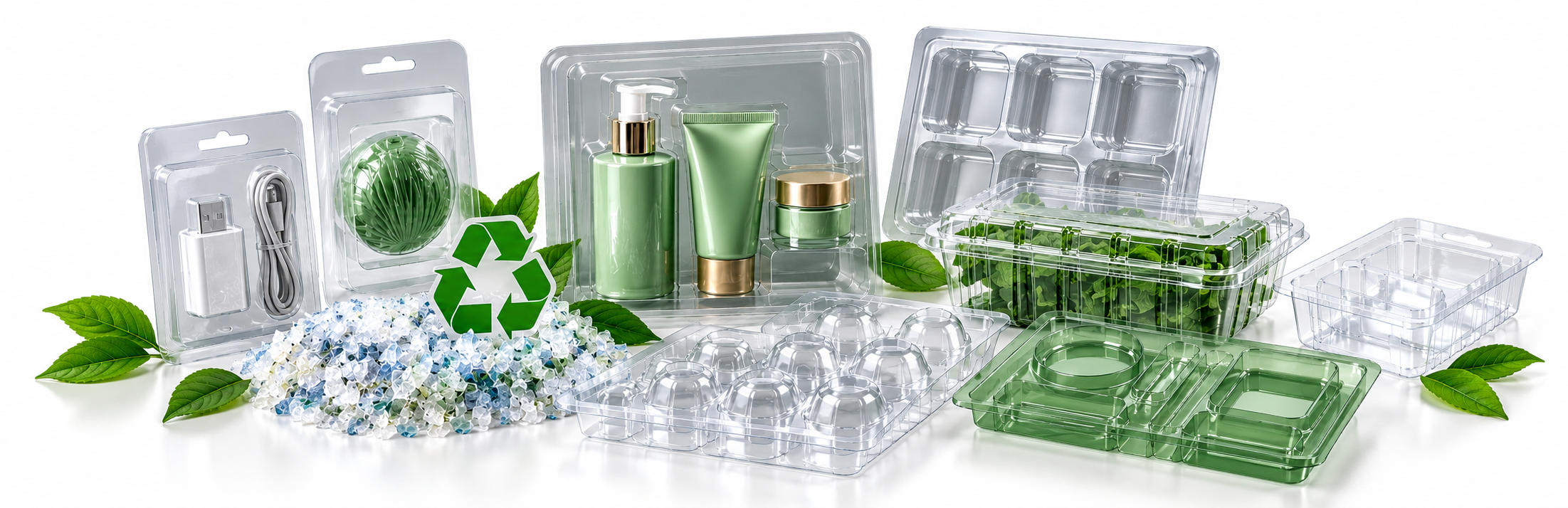
FMCG and Confectionery: Gift trays, retail clamshells, shelf-ready inserts. Seasonal confectionery programmes for large FMCG brands are one of the most active rPET thermoforming categories in India — driven by EPR obligations and brand ESG reporting requirements.
Cosmetics and Personal Care: Perfume inserts, makeup kit trays, gift set display trays. Premium cosmetics brands use rPET for both EPR compliance and brand narrative — sustainable packaging is a marketing differentiator in this category.
Consumer Electronics Accessories: Retail blister and clamshell packaging for cables, earphones, and mobile accessories. At 30–50% PCR, performance is equivalent to virgin PET — and brands with ESG commitments are making it a specification requirement.
Stationery and School Supplies: Display trays, pen/marker blister, school kit packaging. EPR-driven category — straightforward rigid plastic packaging with clear obligations.
Toys:Toy packaging trays, display inserts, retail clamshells. Brands supplying export markets with stringent recycled content requirements are specifying rPET for India-manufactured packaging.
7. Manufacturing Considerations for rPET Thermoforming
Substituting rPET sheet for virgin PET is not plug-and-play. Three manufacturing considerations separate genuine rPET capability from a nominal claim:
- ⚙️ Process parameter adjustment. rPET — particularly at higher PCR levels — has a narrower processing window than virgin PET. Forming temperature, preheat time, and cooling require grade-specific parameters. Thermoformers with genuine rPET capability have documented parameters per PCR grade, not adapted virgin PET settings.
- 📊 Intrinsic viscosity (IV) management. rPET feedstock shows batch-to-batch IV variability that directly affects thermoforming behaviour. Without IV specification ranges or blending protocols, inconsistent results will occur at 75–100% PCR.
- 📁 Documentation chain management. The PCR content certificate from the rPET material manufacturer must be captured per production batch — with lot traceability from material receipt through production output. ISO 9001:2015 certified quality management is the baseline requirement.
8. What to Ask Your Thermoforming Packaging Manufacturer
Go beyond "yes, we can do rPET." These five questions reveal genuine capability:
- ❓ What PCR content levels do you currently process? A genuine rPET thermoformer will cite specific levels — 30%, 50%, 75%, 100%. Vague answers suggest limited experience.
- ❓ Can you provide PCR chain-of-custody documentation per batch? Non-negotiable for EPR compliance. Must trace PCR content from material manufacturer to finished packaging batch.
- ❓ Is food-contact cleared rPET available? Confirm grade and documentation at brief stage for any food-adjacent application.
- ❓ What is your quality management certification? ISO 9001:2015 is the baseline for material traceability and batch documentation.
- ❓ How do you manage rPET feedstock variability? The answer should reference IV specification ranges or blending protocols — not "we adjust as needed.
9. Acting Before Compliance Deadlines — The rPET Opportunity
The rPET transition is not a future trend. It is a present compliance obligation with increasing targets. The brands that transition ahead of deadlines save more than cost:
No last-minute specification changes when EPR targets increase
No gap in ESG reporting documentation chain
Ability to start at 30% PCR and scale to 50%, 75%, or 100% with the same manufacturer — without changing suppliers
Packaging programmes aligned to EPR obligation schedules — planned, not reactive
Ready to Start Your rPET Thermoforming Programme?
Tell us your PCR target, application, and volume. We'll confirm the right grade, timeline, and documentation package — within 24 business hours.